Turning a hand drill into a drill press
A drill held in two hands is a free body. It can tilt in any direction while it cuts, and it usually does. A stand takes away every axis but one.
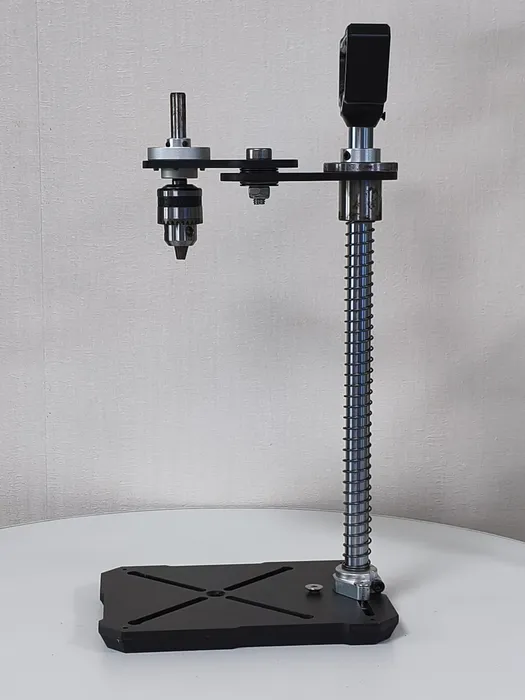
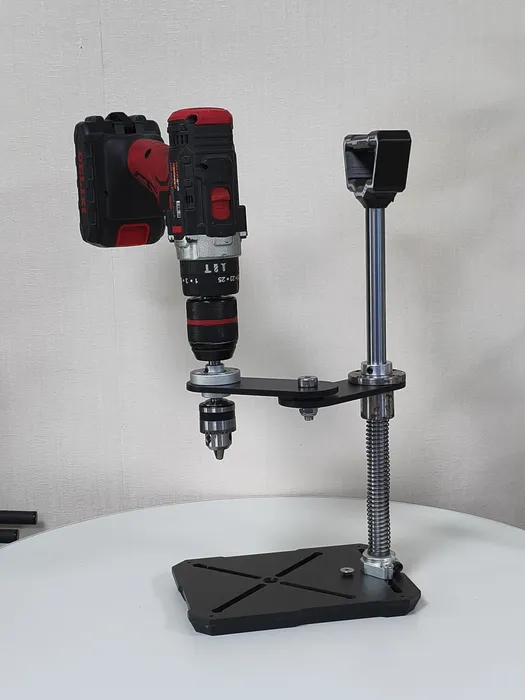
What actually changes
- The bit stops walking. Constrained to a vertical axis, the point starts where you put it instead of skating across the surface.
- Holes come out round. A tilting drill opens the hole into an oval on the way through; a fixed axis does not.
- Repeated holes line up. This is what matters for hinges, brackets and anything bolted to something else.
- Depth becomes controllable. A lever feed is far easier to stop at a set depth than an arm pushing freehand.
What does not change
A stand does not make the drill more powerful, and it does not improve the runout of the drill own chuck. If the chuck already wobbles, the stand will hold that wobble perfectly vertical. For heavy metalwork or large bits, a benchtop press with real spindle bearings remains the right tool.
Buy, or build one
Plenty of people build their own, and the plans are everywhere. The structure is not the difficult part. The difficult part is getting the column square to the base and keeping it square after the joint has been loaded a few hundred times. That perpendicularity, held by machined parts rather than by glue and hope, is the whole product.
Common questions
- Does a drill stand actually help?
- For squareness and repeatability, yes. The stand constrains the drill to one axis, so the bit stops walking at the start of the cut and successive holes stay in line. It does not add torque or improve the drill own spindle accuracy.
- What makes one stand steadier than another?
- Three things: the mass and stiffness of the base, the clearance between column and carriage, and how the drill is clamped. A base that can be bolted or clamped to the bench moves least.
- Can it replace a real drill press?
- For small holes and light work, largely yes. For large-diameter bits, metalwork, or sustained production runs, a benchtop press with proper spindle bearings and more power is still the right tool.
- Is it worth building one instead?
- The hard part of a home-built stand is not the structure, it is keeping the column perpendicular to the base and keeping it there. That perpendicularity is what you are buying.